A car that will not start is usually blamed on the battery, and often that is right. But a new battery fitted to a car with a weak alternator, or with something draining it overnight, will be flat again within days. Working out which of the three you are dealing with saves buying parts you did not need.
Three different problems that look the same
Think of the electrical system as a tank, a tap and a leak:
- The battery is the tank. It stores enough energy to start the engine and run the electronics while the car is off.
- The alternator is the tap. Driven by the engine, it recharges the battery and powers everything while you drive.
- A parasitic drain is the leak. Something keeps drawing current after the car is locked, and empties the tank overnight.
Clues from how the car behaves
| What happens | Most likely cause |
|---|---|
| Jump start works, car runs fine all day, flat again next morning | Worn battery or a parasitic drain |
| Jump start works, but the car dies again while driving | Alternator not charging |
| Battery warning light on while driving | Charging fault: alternator, belt or wiring |
| Lights dim at idle and brighten when you rev | Weak alternator output |
| Slow cranking that gets worse over a few weeks | Ageing battery |
| Flat only after the car sits for several days | Parasitic drain, or a battery with low reserve |
| Whining that rises with engine speed | Alternator bearing or diode fault |
The simple voltage check
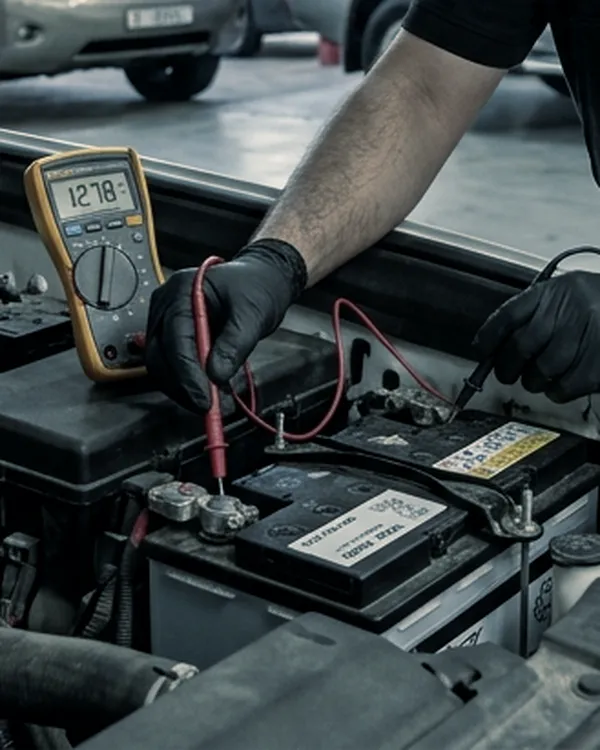
A basic multimeter tells you a lot. Measure across the battery terminals:
- Engine off, car rested for a few hours: around 12.6 volts is a healthy, charged battery. Around 12.2 volts is roughly half charged. Below 12 volts it is close to flat.
- Engine running: most cars should show somewhere between 13.5 and 14.7 volts.
If the running voltage is close to the resting voltage, the alternator is not charging. One caution: many newer cars use smart charging, where the computer lets voltage drop at times to save fuel. A reading slightly under 13.5 volts on these cars can be normal, which is one reason a proper charging system test is more reliable than a single reading.
Royal Garage · open 24/7
Car keeps going flat? Get the battery, charging and drain tested together.
Why batteries die sooner in Dubai
Heat speeds up the chemical wear inside a battery. In a cooler climate a battery might last five years or more. In the UAE, two to three years is common, and a battery can go from fine to dead with very little warning, often at the start of summer or the first cool morning after it.
Cars that are driven only short distances suffer too, because the alternator never gets enough time to fully recharge what the starter used.
Finding a parasitic drain
If the battery tests healthy and the alternator charges properly, but the car still goes flat, something is drawing current with the car locked. Common culprits:
- Aftermarket dashcams, trackers or alarms wired straight to the battery.
- A module that does not go to sleep, often after water ingress or a software fault.
- A glovebox, boot or vanity mirror light staying on.
- A sticking relay keeping a fuel pump or fan powered.
Finding it means letting the car go fully to sleep, which can take a while on modern cars, then measuring the current draw and isolating circuits one at a time until the drain disappears.
Repair or replace the alternator?
Alternators fail in a few typical ways: worn brushes, a failed voltage regulator, a bad diode or a noisy bearing. On some units these parts can be replaced individually. On others, especially compact high-output units on modern cars, a quality replacement or remanufactured alternator is the practical choice. The drive belt and tensioner should be checked at the same time, because a slipping belt gives the same symptoms as a weak alternator.
Replacing the battery on a modern car
On many European cars, and anything with stop-start, the battery has to be the right type (often AGM or EFB) and the car may need to be told a new battery has been fitted. BMW, Audi, Mercedes-Benz and others use a battery sensor to manage charging. If the car still thinks it has the old, worn battery, it can overcharge the new one and shorten its life.
If your car keeps going flat, our electrical repair team tests the battery, charging system and current draw together, so you only replace what has actually failed. For warning lights that appeared at the same time, start with computer diagnostics.
Frequently asked questions
How do I know if it is the battery or the alternator?
If the car starts with a jump and runs normally, then is flat the next morning, suspect the battery or a drain. If it dies again while you are driving, or the battery light is on, suspect the alternator.
Can I drive with a failing alternator?
Only for a short distance. The car runs on battery power alone and will eventually lose power to the engine and electronics, often without much warning.
Will a bad alternator damage a new battery?
It can. An undercharging alternator leaves the battery repeatedly discharged, and an overcharging one can overheat it. Both shorten battery life.
Why did my car battery die with no warning?
Heat damage inside a battery often shows no gradual symptoms. It can test borderline one week and fail the next, especially at the start of summer.
Do I get a price before work starts?
Yes. After testing you receive a written, itemised estimate, and nothing is replaced until you approve it.

Royal Garage workshop team
Written by the mechanics at Royal Garage, Ras Al Khor, Dubai. Updated 15 November 2026.