Most drivers think of AC gas the way they think of engine oil: something that gets used up and needs topping up. It does not work that way. The refrigerant in a car's AC circulates in a sealed loop and is not consumed. If there is less of it than there should be, it has escaped through a leak.
That one fact explains why so many cheap top-ups only work for a few weeks. The gas goes in, the cold air comes back, and the leak lets it out again.
What a proper regas looks like
A regas done properly takes a little longer, but it tells you whether the system can actually hold a charge.
- Recover what is left. The machine pulls out the remaining refrigerant and weighs it. If a system that should hold 650 grams only gives back 200, that is useful information about how fast it is leaking.
- Vacuum the system. Pulling a deep vacuum boils off moisture, which would otherwise mix with the refrigerant and oil and corrode the system from the inside.
- Hold the vacuum. If the vacuum does not hold for the test period, there is a leak big enough to find before going any further.
- Find the leak if there is one. UV dye, an electronic detector or pressure testing with nitrogen shows where gas is escaping.
- Charge by weight. The correct amount is printed on a label under the bonnet. The machine puts in exactly that, plus the correct compressor oil.
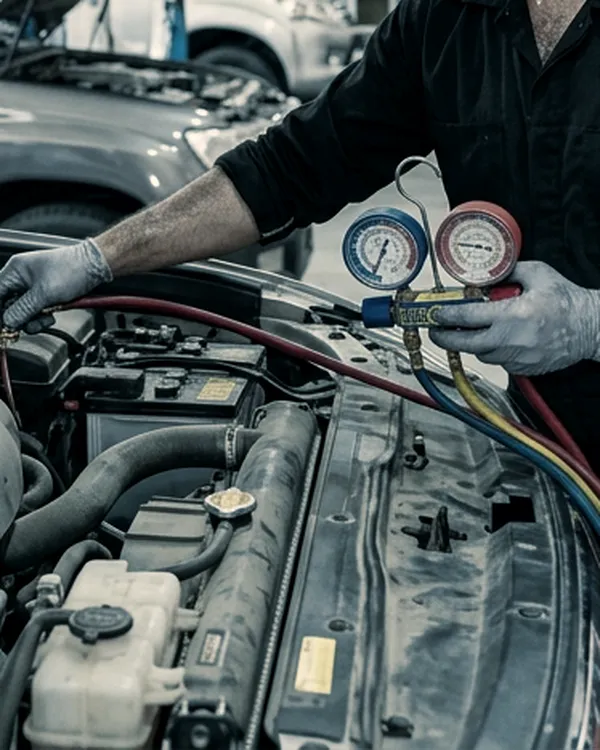
- Test performance. Vent temperature and high and low side pressures are checked with the engine running and the AC on full.
Charging "until the gauge looks right" is guesswork. Too little gas and the AC is weak. Too much and pressures climb, the compressor works harder and cooling actually gets worse.
Where AC systems leak in Dubai cars
- Condenser. It sits right at the front of the car, behind the grille, where stones and road debris hit it. Corrosion around the fins and joints is common.
- O-rings at pipe joints. Rubber seals harden and shrink with years of heat.
- Compressor shaft seal. Leaks here often show as an oily film on the front of the compressor.
- Service valves. The small valves where gas is added can leak like a tyre valve.
- Evaporator. Hidden behind the dashboard, so it is the hardest to reach. A dye trace or a detector at the drain tube usually confirms it.
Royal Garage · open 24/7
AC blowing warm? Have it leak-checked and charged to the correct weight.
When it is not the gas at all
Warm air does not always mean low refrigerant. These faults are common and a top-up will not fix any of them:
| Symptom | Likely cause |
|---|---|
| Cold on the highway, warm in traffic | Condenser fan not running, or a blocked condenser |
| Cold one side, warm the other | Blend door actuator or a dual-zone fault |
| Weak airflow even on full fan | Clogged cabin filter or a failing blower |
| Musty smell when switched on | Mould on the evaporator, often with a blocked drain |
| Cold for ten minutes, then warm | Compressor clutch or pressure switch cutting out, or ice forming |
| Clicking or grinding when the AC engages | Compressor or clutch wear |
A diagnosis that checks pressures, fan operation and compressor engagement before adding any gas avoids paying for refrigerant that was never the problem.
Should a car AC need regular regassing?
In a healthy system, no. Very slow seepage over many years is normal, so a car that is eight or ten years old may eventually need a recharge. But if you are adding gas every summer, something is leaking and fixing it will cost less over time than repeated top-ups.
About DIY cans
Supermarket recharge cans often contain sealant. Sealant can block expansion valves and narrow passages, and it contaminates professional recovery machines, so many workshops will test for it before connecting. The cans also have no way to measure how much is already in the system, which makes overcharging easy.
What decides the cost
Rather than a fixed price, a regas bill depends on a few things:
- Which refrigerant the car uses. Newer cars often use R1234yf, which costs more than the older R134a. Our guide to AC refrigerants explains how to tell which yours has.
- How much the system holds. Large SUVs with rear AC hold far more than a small hatchback.
- Whether a leak needs repairing. An O-ring is a small job. A condenser or evaporator is a bigger one.
You get a written, itemised estimate before any work starts. For anything beyond a straightforward recharge, see our car AC repair page.
Frequently asked questions
How long does a car AC regas take?
A recover, vacuum and recharge usually takes about an hour. If a leak test or repair is needed, it takes longer depending on where the leak is.
Why is my AC cold on the highway but warm in traffic?
That pattern usually points to the condenser fan or a blocked condenser rather than low gas. At speed, air is forced through the condenser. In traffic, the fan has to do that job.
Can too much AC gas damage the system?
Yes. Overcharging raises system pressures, makes the compressor work harder and can reduce cooling. The correct charge is measured by weight from the label under the bonnet.
Is it worth fixing a small AC leak?
Usually, yes. Repeated top-ups add up, and running a system low on refrigerant and oil can wear the compressor, which is one of the most expensive AC parts.
Do I get a price before work starts?
Yes. You receive a written, itemised estimate after the AC has been tested, and nothing is done until you approve it.

Royal Garage workshop team
Written by the mechanics at Royal Garage, Ras Al Khor, Dubai. Updated 15 November 2026.