The amber engine symbol is the car's way of saying that one of its self-tests has failed. It does not tell you how serious the problem is, and it does not tell you which part to buy. What it does give you is a starting point, and the first thing worth knowing is how the light is behaving.
Steady or flashing: the one thing to check first
| What you see | What it usually means | What to do |
|---|---|---|
| Light comes on with the ignition, then goes out | Normal bulb check | Nothing |
| Steady light, car drives normally | A fault has been stored, often emissions or sensor related | Book a diagnosis within the next few days |
| Steady light with rough running, loss of power or a smell | A fault that is affecting how the engine runs | Drive gently and get it checked soon |
| Flashing light | An active misfire bad enough to damage the catalytic converter | Ease off, avoid hard acceleration and stop when it is safe |
| Engine light plus a red temperature or oil warning | A mechanical problem, not just a sensor | Stop the engine and get help |
A flashing light is the one people most often ignore and most often regret. Unburnt fuel from a misfiring cylinder goes straight into the catalytic converter, which can overheat and fail. Converters on many modern cars are expensive, so a coil or plug problem can turn into a much bigger bill within a few days of driving.
Why the code is a clue, not an answer
When the light comes on, the engine computer stores a fault code, for example P0171 (system running lean) or P0302 (misfire on cylinder two). A basic code reader shows that code and nothing more. The trouble is that one code can have many causes.
Take P0171. The engine is getting more air than it expects or less fuel than it needs. That might be a split intake hose, a leaking vacuum line, a dirty airflow sensor, a weak fuel pump or a leaking injector. Replacing the airflow sensor because a website said so is how people end up spending money twice.
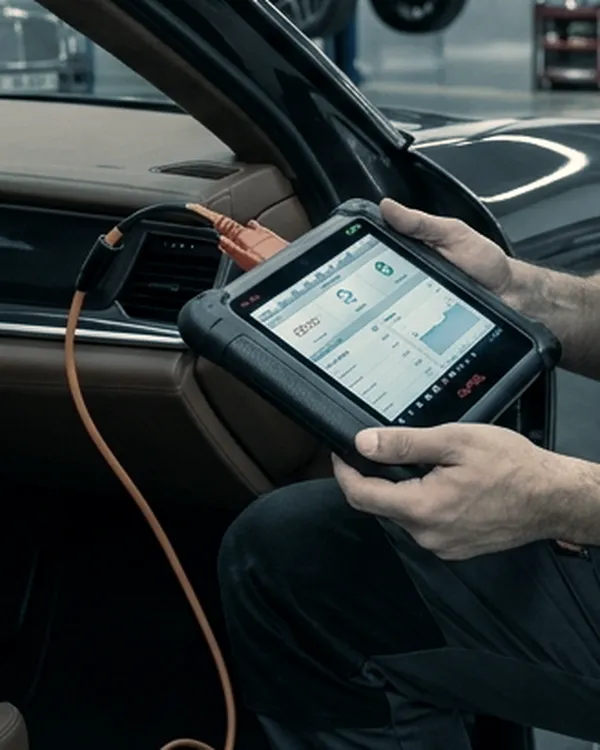
A proper diagnosis looks at more than the code:
- Freeze frame data. A snapshot of speed, temperature, load and fuel trims at the moment the fault was logged.
- Live data. Watching sensor readings while the engine runs, so a lazy oxygen sensor or a drifting temperature reading shows itself.
- Manufacturer-level modules. Generic readers only see the engine. The gearbox, ABS, airbag, air suspension and body modules often hold the code that explains the engine light.
- Physical tests. Smoke testing for vacuum leaks, checking fuel pressure, swapping coils between cylinders to see whether a misfire follows the part.
The faults we trace most often in Dubai
Heat and stop-start traffic are hard on the parts that trigger engine lights. These come up again and again:
- Ignition coils and spark plugs. Coils sit on top of hot engines and crack with age, causing misfires. Plugs left past their interval make it worse.
- Vacuum and intake leaks. Rubber hoses and plastic intake parts harden in the heat and split, giving lean codes and a rough idle.
- Oxygen sensors and catalytic converters. An ageing sensor can trigger efficiency codes. Sometimes the converter really is worn, sometimes the sensor is just slow.
- Thermostats. A thermostat stuck open sets a "temperature below threshold" code and can hurt fuel economy.
- EVAP system leaks. A loose fuel cap, a cracked purge valve or a leaking charcoal canister line. Harmless to drive with, but it will keep the light on.
- Low battery voltage. A tired battery in summer can cause a cluster of random codes across several modules. Testing the battery first saves a lot of guesswork.
Royal Garage · open 24/7
Engine light on? Get it read, traced and explained before you spend on parts.
Can I just clear the light?
You can, and it will often come back. Clearing a code wipes the evidence, including the freeze frame data a technician would use to find the cause. If the fault is still there, the car will find it again on its next self-test.
There is also a practical cost. A car with a warning light on the dash can fail its RTA inspection, and arriving with freshly cleared codes does not fix whatever caused them. Our guide to passing the RTA vehicle inspection covers what the testers look at.
Is it the computer itself?
Owners sometimes ask whether the engine computer (ECU) has failed. It happens, but it is far less common than a wiring, connector or sensor fault. Before anyone condemns an ECU, the power supplies, grounds and wiring to it should be tested, and water ingress or heat damage ruled out. Where an ECU really is faulty, the options are repair, a replacement unit coded to the car, or a software update if the manufacturer has released one for the fault.
What to tell the mechanic
You will get to the answer faster if you can say:
- When the light first came on, and whether it was steady or flashing.
- Anything that changed at the same time: refuelling, a jump start, a car wash, a recent repair.
- Whether the car feels different: hesitation, vibration, idle, fuel use, smells.
- Any other warning lights, even if they went away again.
With that, a diagnosis is usually quick. Our computer diagnostics can be done wherever the car is parked in Dubai, and you get a written explanation of what was found and an itemised estimate before anything is replaced. If the car has a gearbox warning as well, see automatic transmission repair.
Frequently asked questions
Is it safe to drive with the check engine light on?
If the light is steady and the car drives normally, it is usually safe to drive for a short time while you arrange a diagnosis. If it is flashing, or the car is running badly, reduce speed and stop when it is safe, because continued driving can damage the catalytic converter.
Why does the check engine light come on and then go off by itself?
Many faults are intermittent. The computer turns the light off after several drive cycles without seeing the fault, but the code usually stays stored in memory, so it can still be read and traced.
Will a loose fuel cap really turn on the engine light?
Yes. The evaporative emissions system tests itself for leaks, and a cap that is not sealing properly can fail that test. Tighten it until it clicks and the light may go out after a few days of driving.
How long does a diagnosis take?
A scan and initial look usually take under an hour. Intermittent faults or electrical problems can take longer because they need testing under the right conditions.
Do I get a price before work starts?
Yes. After diagnosis you receive a written, itemised estimate, and nothing is replaced until you approve it.

Royal Garage workshop team
Written by the mechanics at Royal Garage, Ras Al Khor, Dubai. Updated 15 November 2026.